
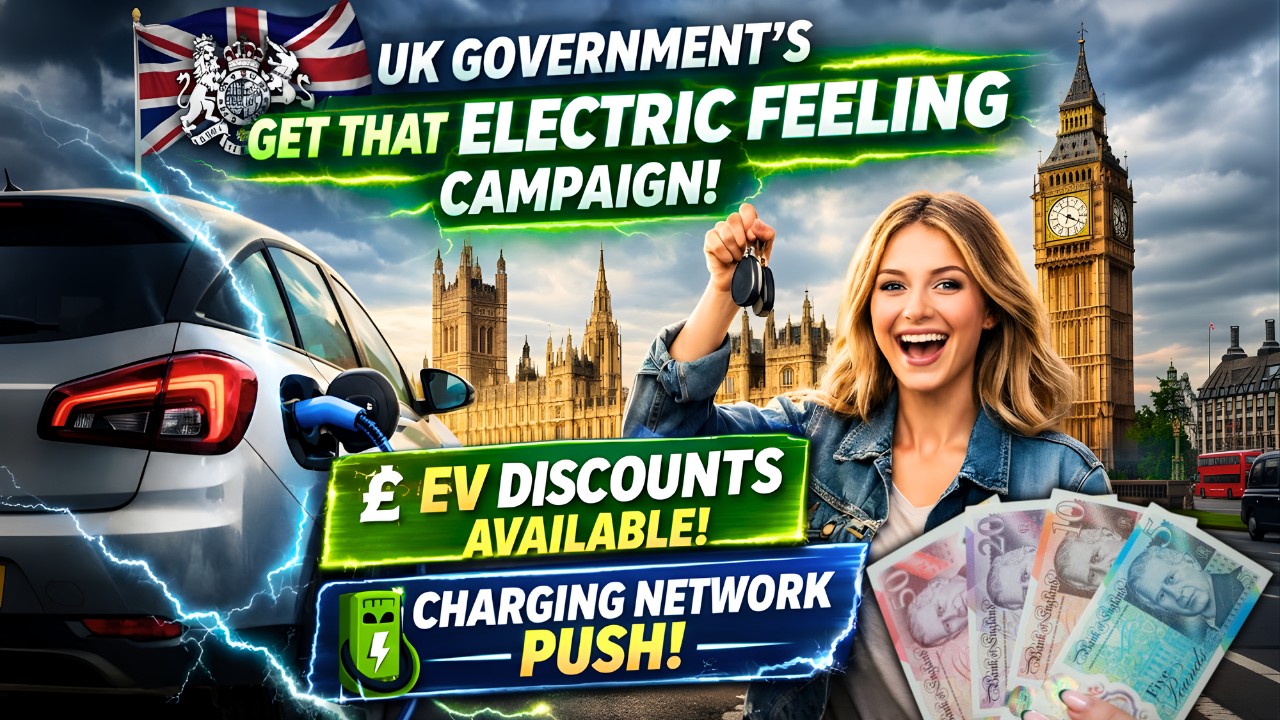
UK Get That Electric Feeling Campaign: The “Get That Electric Feeling” campaign is an official UK Government initiative led by the Department for Transport. Its main purpose is to encourage drivers to consider electric vehicles as a practical, affordable, and everyday choice rather than a future or luxury option. The campaign focuses on three core areas: cost savings, expanding charging infrastructure, and improving public understanding of how EVs fit into daily life.
This campaign is being promoted nationwide through television, digital platforms, radio, outdoor advertising, and social media. The tone is deliberately simple and relatable, targeting families, commuters, and first-time EV buyers rather than only environmentally motivated drivers.
Key Objectives Set by the Government
The government has clearly outlined what it wants to achieve through this campaign. The main objectives include:
- Increasing public confidence in electric vehicles
- Addressing misconceptions around EV costs and charging availability
- Supporting the transition away from petrol and diesel vehicles before 2030
- Reducing transport-related carbon emissions
- Encouraging manufacturers and local authorities to accelerate infrastructure rollout
By aligning public awareness with financial and infrastructure support, the campaign aims to turn interest into action.

Electric Vehicle Discounts and Financial Support
A major highlight of the campaign is the emphasis on direct and indirect savings for drivers. The UK Government has confirmed that financial incentives are still a key part of its EV strategy, even as technology matures.
Main Financial Measures for EV Buyers
- Electric Car Grant offering discounts of up to £3,750 on eligible new electric cars
- Eligibility focused on vehicles priced below £37,000 to support mass-market adoption
- Manufacturer-applied discounts passed directly to consumers at point of sale
- Significant savings on fuel costs compared to petrol and diesel vehicles
- Lower maintenance costs due to fewer moving parts in EVs
- Reduced or zero road tax for many electric models
- Strong tax advantages for company car drivers choosing EVs
Estimated Cost Comparison Table
| Cost Area | Petrol/Diesel Car | Electric Vehicle |
|---|---|---|
| Average fuel/energy cost per year | Higher and price-volatile | Lower and more stable |
| Maintenance and servicing | Regular engine servicing | Reduced maintenance |
| Vehicle tax | Standard rates apply | Often zero or reduced |
| Company car tax | Higher benefit-in-kind | Significantly lower |
The campaign highlights that when these factors are combined, many drivers can save over a thousand pounds per year despite a higher upfront purchase price.
Expansion of the UK Charging Network
Charging access remains one of the most important concerns for potential EV buyers. The government has addressed this directly by linking the campaign with major infrastructure investment already underway.

Current Status of Public Charging
- More than 80,000 public chargepoints now installed across the UK
- Annual growth rate of public chargers exceeding 20 percent
- Rapid chargers increasingly available on motorways and major A-roads
- Charging points now common at supermarkets, retail parks, and workplaces
Planned Charging Infrastructure Developments
- Over 100,000 additional local chargepoints planned nationwide
- Strong focus on residential streets and urban areas without driveways
- Funding support for local councils to install on-street chargers
- Investment in fast and ultra-rapid charging technology
- Support for off-grid and innovative charging solutions
The campaign messaging reassures drivers that they do not need to rely solely on home charging and that public infrastructure is becoming more visible and reliable.
Role of Local Authorities and Private Sector
The government has made it clear that EV adoption is not a central-government-only effort. Local councils and private companies are key partners in delivering charging access.
Their responsibilities include:

- Identifying high-demand residential charging areas
- Installing overnight chargers in urban streets
- Partnering with energy companies and chargepoint operators
- Ensuring fair pricing and accessibility
This shared approach is intended to reduce regional inequality in charging access.
Environmental and Economic Impact
Transport remains one of the UK’s largest sources of carbon emissions. The campaign plays a strategic role in the country’s wider climate commitments.
Environmental Benefits Highlighted
- Zero tailpipe emissions from electric vehicles
- Improved air quality in cities and towns
- Reduced noise pollution
- Contribution to national net-zero targets
Economic Benefits for the UK
- Support for domestic EV manufacturing
- Growth in battery production and supply chains
- Job creation in green technology and infrastructure
- Long-term reduction in fossil fuel dependency
The government views EV adoption as both an environmental necessity and an economic opportunity.

Addressing Public Concerns and Misconceptions
The campaign directly addresses common doubts that still prevent some drivers from switching.
Key concerns and responses include:
- Range anxiety is reduced as modern EVs offer longer real-world ranges
- Charging times are faster with rapid and ultra-rapid chargers
- Daily driving needs are often well below EV range limits
- Most EV owners report high satisfaction and would not return to petrol vehicles
By focusing on lived experiences rather than technical jargon, the campaign aims to build trust.

How This Campaign Fits into Long-Term Policy
“Get That Electric Feeling” supports the UK’s long-term policy direction, including the planned end of new petrol and diesel car sales by 2030. Rather than introducing new rules, the campaign focuses on preparing the public for changes that are already coming.
It also signals continued government commitment to EV adoption, which is important for manufacturers, investors, and local authorities planning long-term projects.
Remaining Challenges
Despite progress, challenges remain:
- Upfront vehicle prices are still high for some households
- Charging access is uneven between regions
- Grid capacity and energy demand need careful management
- Consumer trust depends on real-world reliability, not advertising
The success of the campaign will depend on how quickly infrastructure growth keeps pace with rising EV demand.
Conclusion
The UK Government’s “Get That Electric Feeling” campaign represents a practical and well-timed push toward mainstream electric driving. By combining clear messaging, real financial incentives, and visible charging infrastructure growth, the campaign aims to remove hesitation and normalize EV ownership.
For drivers, the message is straightforward: electric vehicles are no longer experimental or inconvenient. With discounts available, charging networks expanding, and long-term savings becoming clearer, the transition to electric transport is being positioned as both sensible and achievable for everyday life.